
The Temple of Vesta: Architecture of Rome's Sacred Fire
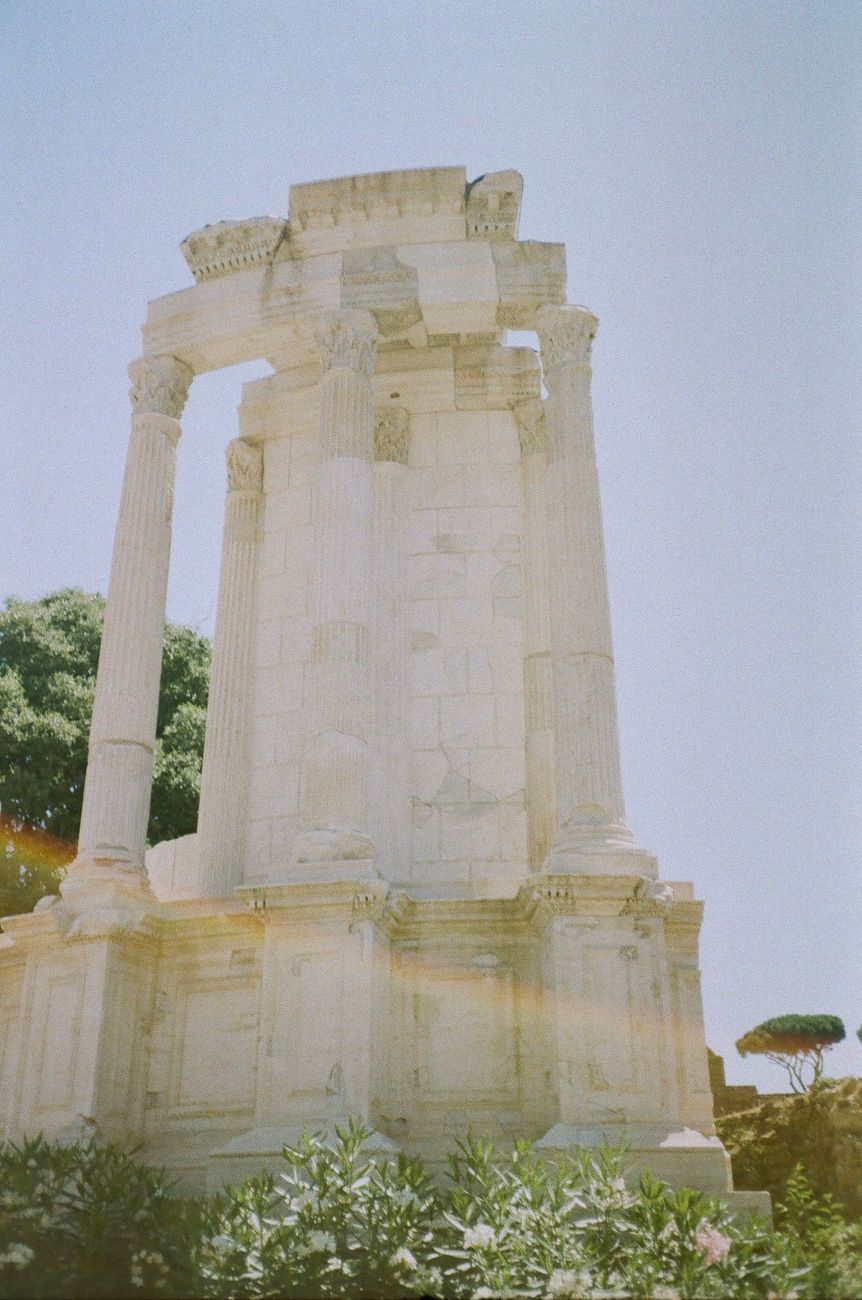
Nearly every major temple in the Roman Forum used a rectangular plan with a front porch and columns, except one. The Temple of Vesta was circular, a deliberate architectural choice that ancient writers connected to old ideas about hearth fires and even the shape of the world itself. Inside, six Vestal Virgins kept a flame burning that Romans believed must never go out, under penalty of disaster for the state.
Why a round temple at all
The circular design of the Temple of Vesta is usually explained as a deliberate echo of the earliest Roman hearths and round huts, since Vesta was fundamentally a goddess of the hearth fire, first of the household and then, through her state cult, of Rome as a collective household. Ovid, writing in the Fasti, explicitly connects the temple's round shape to ideas about the earth's own form, suggesting ancient Romans themselves read symbolic meaning into the building's unusual geometry rather than treating it as architecturally incidental. This made the temple visually distinct from its rectangular neighbors in the Roman Forum, including the nearby Temple of Castor and Pollux.
A flame that was never supposed to go out
At the center of the temple's religious function was a perpetual fire, maintained continuously by the Vestal Virgins, the only full-time female priesthood in Roman state religion. If the fire went out, Romans considered it a serious portent requiring expiation, and the Vestal responsible could reportedly be punished, in some accounts by flogging. Relighting the fire, when it did go out, had to be done without using an ordinary flame, instead using methods such as friction from a special type of wood or concentrating sunlight with a lens, underscoring that this had to be a 'pure,' freshly generated fire rather than one simply carried over from elsewhere.
The sacred objects nobody but the Vestals could see
Beyond the fire itself, Roman tradition held that the temple's inner sanctum stored sacred objects tied to the state's survival, reportedly including the Palladium, a statue said to have been brought from Troy by Aeneas, though access to this innermost space was restricted so completely that most Romans, including male magistrates, were barred from entering under normal circumstances. This secrecy itself became part of the temple's mystique; ancient writers acknowledge uncertainty about exactly what the inner sanctum held, since so few people were ever permitted to see it directly.
The Vestals' house next door
The Vestal Virgins lived in the adjoining Atrium Vestae, the House of the Vestals, a large residential complex whose excavated remains, including a central courtyard pool and rows of statue bases honoring senior Vestals, still stand beside the temple ruins today. This physical adjacency meant the priestesses' daily lives were structured entirely around their proximity to the fire they tended, a arrangement unlike most other Roman priesthoods, whose members typically lived ordinary lives outside any dedicated religious compound.
| Phase | Date | Notes |
|---|---|---|
| Legendary founding | Attributed to King Numa, 8th-7th century BC | Tradition, not independently confirmed archaeologically |
| Early Republican rebuilding | Multiple times, exact dates uncertain | Temple damaged by recurring Forum fires |
| Augustan-era repair | c. 12 BC | Augustus became Pontifex Maximus and took direct interest in Vestal cult |
| Severan rebuild | c. 191 AD | Rebuilt after fire under Julia Domna, wife of Septimius Severus; present ruins mostly date here |
| Fire extinguished permanently | 391 AD | Under edict of Theodosius I banning pagan sacrifice |
Becoming a Vestal
Serving at this temple required an extraordinary commitment. Girls selected as Vestal Virgins, typically between six and ten years old, were chosen by the Pontifex Maximus from eligible families and bound to thirty years of service: ten years learning their duties, ten years performing them, and ten years training younger Vestals. During this period they took a vow of chastity, and breaking it was treated as a capital offense; a Vestal found guilty of unchastity could be buried alive in an underground chamber known by tradition as the Campus Sceleratus, a punishment that avoided the religious complication of directly shedding a Vestal's blood. In exchange for these extreme demands, Vestals enjoyed privileges almost no other Roman women held, including the right to own property independently, testify in court without a male guardian's backing, and receive a reserved seat at public games. This unusual combination of severe risk and genuine civic power made the priesthood attached to this temple one of the most distinctive institutions in Roman religious life.
Visitor checklist: what survives at the site today
- A partial reconstruction of several columns, re-erected in the early 20th century, giving a sense of the temple's circular colonnade.
- The original foundation and podium beneath the standing columns.
- Extensive remains of the adjoining House of the Vestals, including the courtyard pool and inscribed statue bases.
- No surviving ancient fire or flame, obviously, and no access to any original inner sanctum contents, none of which survive.
Common mistakes about the Temple of Vesta
- Assuming the standing columns are ancient in their current arrangement. Several were re-erected and partially reconstructed during 20th-century restoration work, not found standing in that exact configuration.
- Thinking the temple's circular shape was unique among all Roman buildings. Other round structures existed in Roman architecture, but a circular plan was unusual specifically among major state temples, most of which followed a rectangular design.
- Believing the fire was mystically ancient and literally unbroken from Numa's reign. It is well documented that the fire did go out on various occasions and had to be reignited through ritual means, despite the ideal of continuity.
- Confusing the Temple of Vesta with the larger House of the Vestals next door. These are two distinct, adjoining structures with different functions, residential versus purely religious.
The Vestals' unusually prominent public role sits alongside other major cult structures nearby, including the Temple of Saturn at the opposite end of the Forum and the state's chief temple on the Capitoline Hill. For more related sites, browse the sacred places and monuments category.
Sources
- Ovid, Fasti (Book 6) — Describes the temple's circular design and its symbolic connection to the earth's shape.
- Livy, Ab Urbe Condita (Book 1) — Attributes the founding of the Vestal cult and its temple to King Numa Pompilius.
- Plutarch, Life of Numa (General) — Describes the Vestal priesthood's origins and duties related to the sacred fire.
- Pliny the Elder, Natural History (Book 28) — References Vestal ritual practices and sacred objects associated with Roman state religion.
Frequently asked questions
Why was the Temple of Vesta round instead of rectangular like most Roman temples?
Its circular shape is generally explained as a deliberate echo of early Roman round hearths and huts, fitting Vesta's role as goddess of the hearth fire; Ovid's Fasti connects the shape symbolically to ideas about the earth itself.
What happened if the sacred fire in the Temple of Vesta went out?
Romans treated this as a serious bad omen requiring ritual expiation. The responsible Vestal Virgin could reportedly face punishment, and the fire had to be relit using a 'pure' method, such as friction fire-starting, rather than simply carried over from another flame.
When did the sacred fire of Vesta finally stop burning?
The fire was permanently extinguished around 391 AD, following an edict from the emperor Theodosius I banning pagan sacrifice and religious practice across the empire.
Are the columns standing at the Temple of Vesta today original?
Several were re-erected during early 20th-century restoration efforts using recovered ancient fragments, so what visitors see is a partial modern reconstruction rather than columns found standing exactly as shown.