
The Roman Forum: The Religious Heart of Rome
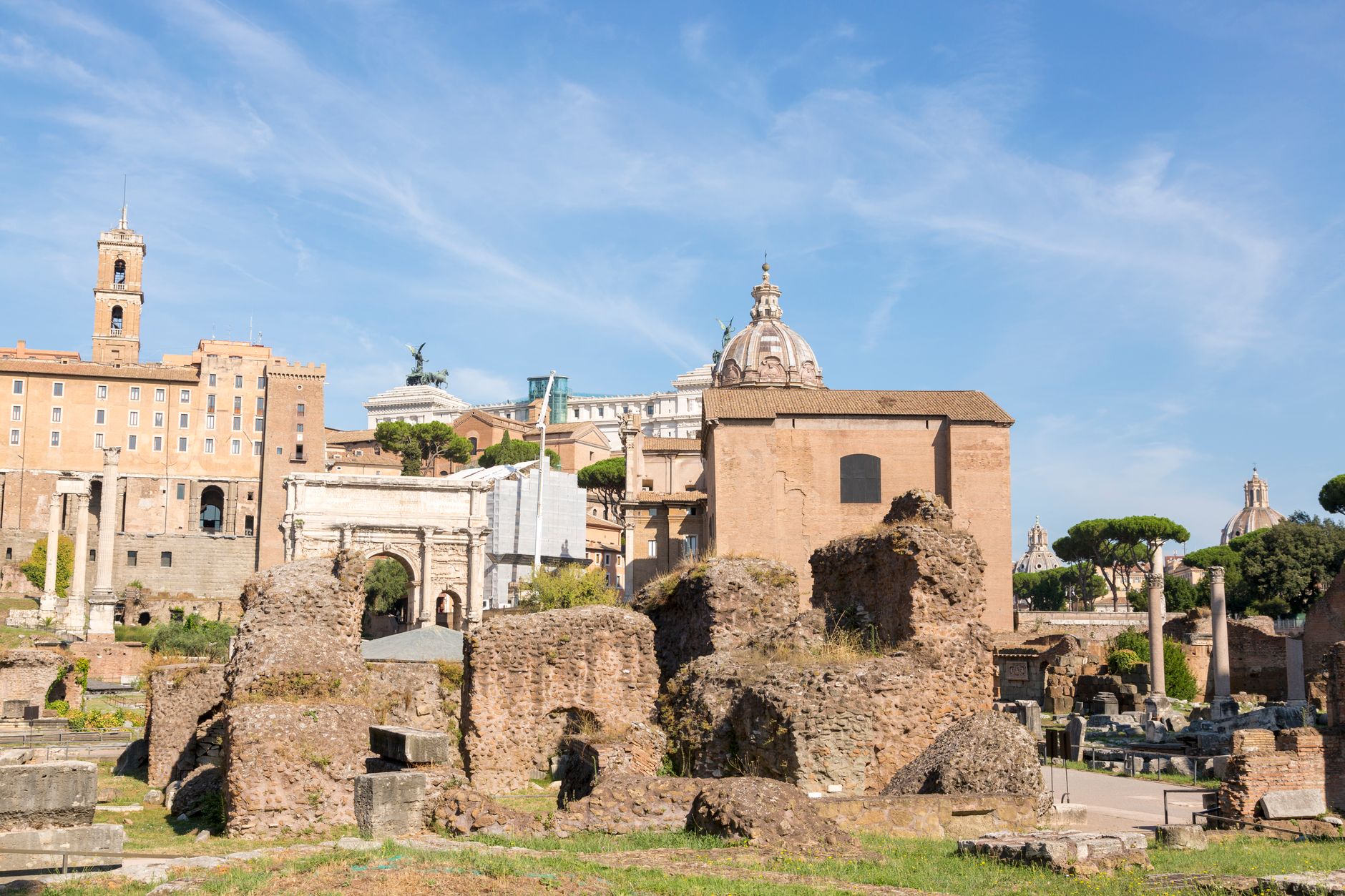
Before the Roman Forum held a single temple, the valley between the Palatine and Capitoline hills was a marsh where Tiber floodwater pooled and early inhabitants buried their dead. Drained around the 6th century BC by the great sewer known as the Cloaca Maxima, this reclaimed strip of low ground became the most important religious and civic space in the ancient world, lined with temples, shrines, and altars that ordinary Romans walked past every day for over a thousand years. Most visitors today see broken columns and foundation stones; few realize how much ritual activity once happened on this exact ground.
Draining a swamp into sacred ground
Archaeological excavation beneath the Forum's paving has uncovered burials dating to roughly the 10th and 9th centuries BC, evidence that the valley was used as a cemetery long before it became a public square. Tradition credited the Etruscan-descended kings of Rome, particularly Tarquinius Priscus, with organizing the drainage of the marsh using the Cloaca Maxima, a monumental covered drain that still partially survives and that ancient writers treated as one of early Rome's great engineering feats. Once dry, the valley quickly filled with small shrines predating any grand architecture, several of which later generations of Romans deliberately preserved even as monumental building rose around them.
The Lapis Niger and the city's oldest shrines
Near the Senate House sits the Lapis Niger, a patch of black marble paving that Roman tradition linked to an extremely old and sacred spot, with some ancient writers connecting it to the legendary burial place of Romulus himself. Beneath the black stone, excavators found an archaic altar and a stele bearing one of the oldest known Latin inscriptions, too damaged and archaic to translate with full confidence but clearly religious in nature. Nearby stood the Vulcanal, an open-air shrine to Vulcan, and the small circular Temple of Janus, whose doors were traditionally closed only in times of total peace across the Roman world, a condition so rare that ancient sources could count on their fingers how often it happened.
Temples that anchored Roman religious life
Along the Forum's edges stood the buildings that gave Roman public religion its daily rhythm. The circular Temple of Vesta held the city's perpetual sacred fire, tended by the Vestal Virgins who lived next door in the House of the Vestals. The Temple of Saturn, at the foot of the Capitoline, doubled as the state treasury and anchored the December festival of Saturnalia. The Temple of Castor and Pollux, rebuilt multiple times, commemorated the twin gods who, according to legend, appeared on the battlefield of Lake Regillus to aid Rome. The Regia, traditionally the residence of Rome's early kings, later served as the headquarters of the Pontifex Maximus, the chief priest of the state religion.
Processions, trials, and sacred theater
The Forum was not a quiet museum of buildings; it was a working stage for Roman religious and political life. Triumphal processions for victorious generals wound through the Forum on their way up to the Temple of Jupiter Optimus Maximus on the Capitoline Hill, the ultimate goal of every triumph. Public funerals for prominent Romans included a laudatio funebris, a eulogy delivered from the Rostra, the speaker's platform, in front of ancestral wax masks carried by family members. In 44 BC, Julius Caesar's body was cremated in the Forum itself, near the site of a makeshift altar the crowd built on the spot, after Mark Antony's funeral oration turned public grief into open anger. The comitia, Rome's popular assemblies, also met at the Forum's edges to vote on laws and elect magistrates, meaning political and religious authority physically overlapped on the same ground.
Fire, rebuilding, and the imperial forum
The Forum visitors see today is overwhelmingly an Imperial-period reconstruction, not the Forum of the early Republic. Fires, especially a major blaze in 283 AD under the emperor Carinus, damaged or destroyed several buildings that had already been rebuilt more than once. Augustus undertook an extensive building and restoration program around the turn of the millennium, and later emperors, including Domitian and Septimius Severus, who erected his triumphal arch at the Forum's western end around 203 AD, continued adding monuments for centuries after the Republic had ended. Layers of rebuilding mean that a single temple podium often contains masonry from several different centuries stacked on top of one another.
| Structure | Traditional/earliest date | Notable rebuilding |
|---|---|---|
| Temple of Vesta | Attributed to King Numa, 7th century BC (legendary) | Rebuilt after fires; present remains mostly Severan era, c. 191 AD |
| Temple of Saturn | Dedicated 497 BC | Current ruins date to a late 4th-century AD rebuild |
| Temple of Castor and Pollux | Dedicated 484 BC | Standing columns from a Tiberian-era rebuild, early 1st century AD |
| Curia Julia (Senate House) | Begun under Julius Caesar, 44 BC | Current brick building is a Diocletianic rebuild, c. 283 AD |
| Arch of Septimius Severus | Dedicated 203 AD | Commemorates victories over Parthia; largely intact |
What you can still see there today
- Eight surviving granite columns and part of the architrave of the Temple of Saturn.
- The brick Curia Julia, the best-preserved Roman senate house anywhere, though it is a later rebuild.
- The Arch of Titus and the Arch of Septimius Severus, both largely intact triumphal arches.
- Foundations and some columns of the Temple of Vesta and the adjoining House of the Vestals.
- The Lapis Niger pavement and, beneath it in a protected area, the archaic altar and stele.
- The Rostra platform site, near where Caesar's funeral oration was delivered.
Common mistakes about the Roman Forum
- Thinking the Forum was mainly a marketplace. It began with some commercial activity, but by the mid-Republic it functioned primarily as a religious and political center; everyday retail business shifted to other, purpose-built markets.
- Assuming every standing column dates to the Republic. Most visible columns, including those of the Temple of Saturn and the Temple of Castor and Pollux, belong to Imperial-era rebuilds, sometimes centuries after the original dedication.
- Confusing the Roman Forum with the later Imperial Fora. Augustus, Trajan, and other emperors built separate forum complexes nearby; these are distinct structures from the original Forum Romanum.
- Believing the current Curia Julia is Caesar's original Senate House. The building standing today is a Diocletianic-era reconstruction from around 283 AD, after fire destroyed earlier versions.
Much of what made the Forum sacred radiated outward from the hill looming above it; the Capitoline Hill and its Temple of Jupiter Optimus Maximus gave the valley its ultimate point of reference, while the Palatine Hill on the opposite side anchored Rome's foundation legends. For the full set of sacred sites this cluster covers, see the sacred places and monuments category.
Sources
- Livy, Ab Urbe Condita (Book 1) — Describes early regal-period building activity traditionally linked to the Forum's drainage and early shrines.
- Dionysius of Halicarnassus, Roman Antiquities (Book 3) — Discusses early Roman urban development including the Forum area.
- Varro, De Lingua Latina (Book 5) — Comments on the names and origins of several Forum landmarks.
- Tacitus, Annals (General) — Records Imperial-era events and rebuilding connected to Forum monuments.
- Suetonius, Life of Julius Caesar (Divus Iulius 84) — Describes the improvised cremation of Caesar in the Forum.
Frequently asked questions
Was the Roman Forum a marketplace or a religious site?
It functioned as both early on, but from the mid-Republic onward it operated primarily as Rome's religious and political center, hosting temples, state ceremonies, trials, and assemblies, while everyday commerce moved to dedicated markets elsewhere in the city.
How old are the ruins visible in the Roman Forum today?
They span many centuries. Some foundations trace back to the early Republic, but most standing columns and buildings, including the Curia Julia and the Temple of Saturn's columns, are Imperial-era rebuilds dating from the 1st to the 4th century AD.
Where was Julius Caesar cremated?
According to ancient accounts, an angry crowd built an improvised pyre and altar in the Roman Forum itself after Mark Antony's funeral oration, near the site later marked by a small shrine, rather than at a traditional cemetery.
What is the Lapis Niger?
The Lapis Niger is a patch of black marble paving in the Forum traditionally linked to a very old sacred spot; excavation beneath it revealed an archaic altar and an early Latin inscription, among the oldest found in Rome.