
The Palatine Hill: Myth, Religion, and the Birthplace of Rome
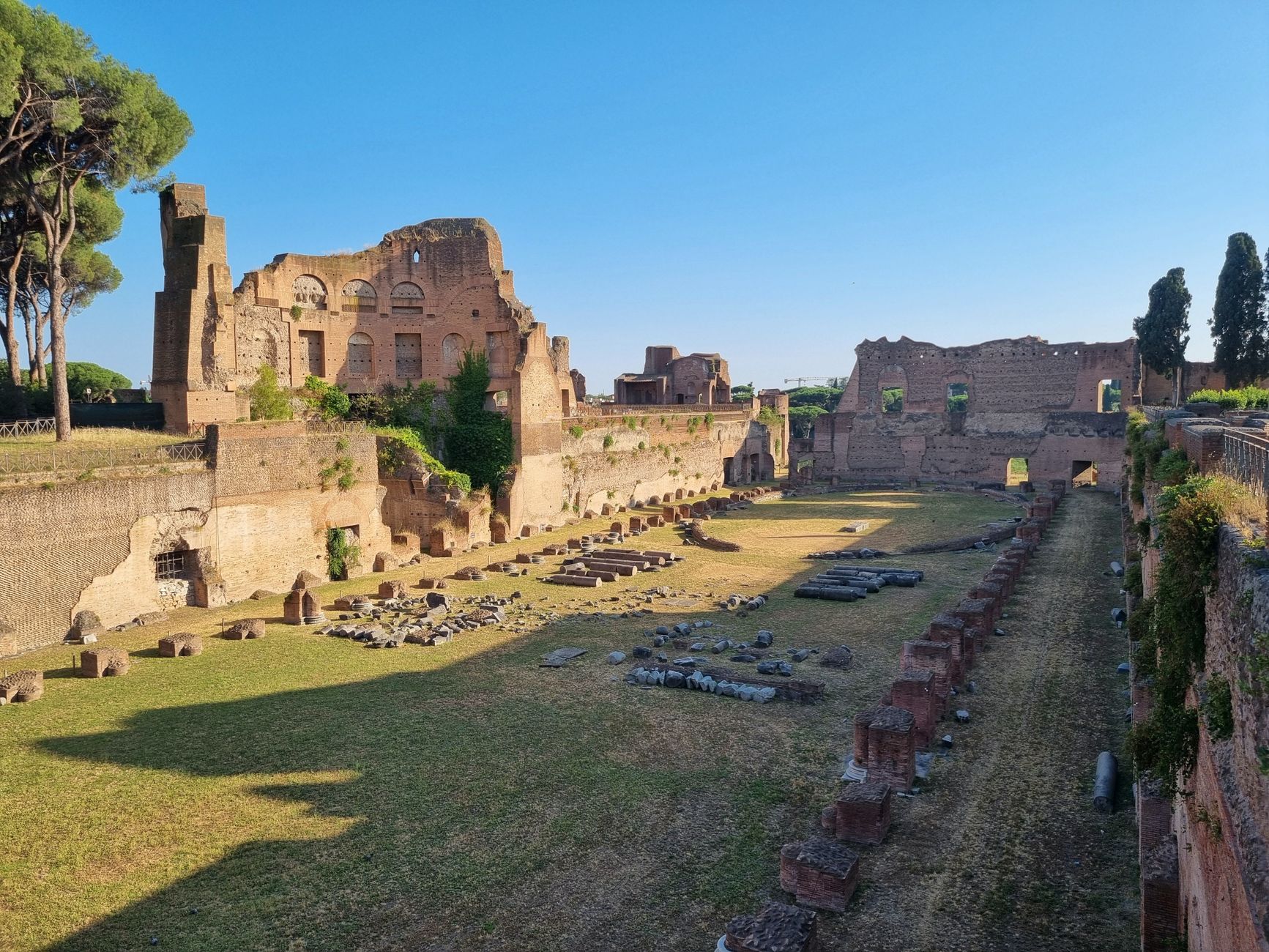
On the Palatine Hill, archaeologists uncovered the postholes of a small hut dating to around the mid-8th century BC, roughly the same period Roman tradition assigned to the city's founding by Romulus in 753 BC. This does not prove the Romulus story happened exactly as later writers told it, but it is one of the closest points anywhere in the ancient world where legend and excavated evidence sit this near to each other in time and place.
The hill Rome's own origin story points to
Roman foundation legend places almost every key event of Rome's earliest history on or around the Palatine Hill: the she-wolf nursing Romulus and Remus at the nearby Lupercal cave, Romulus plowing the sacred boundary furrow of his new settlement, and the killing of Remus in a dispute over the city's layout. Ancient writers, including Livy and Plutarch, treat the hill as the literal site of Rome's first walled settlement, a small fortified village rather than anything resembling the later imperial city.
What archaeology actually found
Excavations led in the 20th century, particularly by archaeologist Andrea Carandini, uncovered a ditch and wall on the Palatine's northern slope that some researchers have associated with the legendary pomerium, the sacred boundary Romulus is said to have plowed. Carbon dating and pottery analysis placed these features in the mid-8th century BC, close to the traditional founding date of 753 BC calculated by the later Roman scholar Varro. It is important to be precise about what this shows: it confirms a genuine Iron Age settlement existed on the Palatine at roughly the right time, not that Romulus himself was a real historical individual or that events matched the literary legend detail for detail.
The Casa Romuli: a hut kept as a relic
Remarkably, ancient sources describe a simple thatched hut on the Palatine, called the Casa Romuli, that Romans maintained and repaired for centuries, believing it to be Romulus's own house or a faithful replica of it. Writers including Dionysius of Halicarnassus mention its deliberate preservation well into the Imperial period, a kind of living monument kept in its humble original form even as marble palaces rose around it. This practice shows Romans were themselves consciously engaged in memory-making about their origins, maintaining a symbol of founding-era simplicity in the middle of an increasingly grand aristocratic neighborhood.
From humble huts to imperial palaces
Over the following centuries, the Palatine transformed from a cluster of early huts into Rome's most exclusive residential address. By the late Republic, senators and wealthy families, including Cicero, built elaborate houses there. Augustus deliberately chose the Palatine for his own residence, consciously echoing Romulus's legendary presence on the same hill, and later emperors expanded this into a continuous palace complex; the English word 'palace' itself derives from 'Palatine.' The House of Augustus and the House of Livia, excavated and partially open to visitors, preserve some of the finest surviving Roman wall paintings anywhere.
The Temple of Apollo Palatinus
Augustus added a major religious structure to the hill beyond his own house: the Temple of Apollo Palatinus, vowed after his naval victory at Actium in 31 BC and dedicated in 28 BC. The temple stood directly beside the emperor's residence, deliberately blurring the line between his private home and public state religion, and it housed a library and a portico decorated with statues of the Danaids. Augustus connected himself publicly to Apollo throughout his reign, and locating this temple so close to his own house on the same hill where tradition placed Romulus reinforced the message that his rule continued, rather than broke with, Rome's founding past. Ancient sources describe the temple's doors as carved with scenes referencing Apollo's mythology, and its associated portico later became a venue for literary recitations under Augustus's successors.
| Period | Approx. date | What stood on the Palatine |
|---|---|---|
| Early Iron Age settlement | c. 8th century BC | Huts, ditches, possible boundary wall (archaeologically confirmed) |
| Legendary founding | 753 BC (traditional) | Romulus's settlement, per literary tradition |
| Republican elite housing | 2nd-1st century BC | Aristocratic houses, including Cicero's residence |
| Augustus's residence | from c. 36 BC | House of Augustus built near the Lupercal and Casa Romuli site |
| Imperial palace complex | 1st century AD onward | Domus Flavia and Domus Augustana under the Flavian emperors |
Legend vs confirmed archaeology: a quick comparison
- Legendary claim: Romulus founded Rome on the Palatine in 753 BC by plowing a sacred furrow. Archaeological status: A ditch and wall feature from roughly this period exists, but direct confirmation of Romulus as a historical founder is not possible.
- Legendary claim: The Casa Romuli was Romulus's actual house. Archaeological status: Ancient sources confirm a hut of this type was maintained as a relic; its true age and authenticity as Romulus's literal dwelling cannot be verified.
- Legendary claim: The she-wolf nursed the twins at the Lupercal. Archaeological status: A cave or grotto feature near the Palatine's base was venerated under this name in antiquity; this is a religious tradition, not a provable historical event.
Common mistakes about the Palatine Hill
- Treating the mid-8th-century BC hut remains as proof Romulus existed. The dating lines up with tradition, but it does not confirm any individual founder or the specific events ancient authors describe.
- Assuming the ruins visible today are from the earliest settlement. Almost all standing structures on the Palatine, including the Domus Augustana, date from the late Republic through the high Empire, centuries after the hill's earliest huts.
- Confusing the Palatine with the Capitoline. The Capitoline Hill housed the state's chief temple to Jupiter; the Palatine is tied instead to Rome's founding legend and later became an imperial residential district.
- Thinking 'palace' always meant a single grand building. The Imperial-era complex on the Palatine grew incrementally over multiple emperors' reigns rather than being built as one unified project.
The hill's religious significance did not stand alone; it connected directly to the sacred valley of the Roman Forum below and to the cult site of Hercules at the nearby Ara Maxima. For the full set of related sites, see the sacred places and monuments category.
Sources
- Livy, Ab Urbe Condita (Book 1) — Gives the literary account of Romulus's founding of Rome on the Palatine.
- Plutarch, Life of Romulus (General) — Describes the founding legend and the Palatine's role in it.
- Dionysius of Halicarnassus, Roman Antiquities (Book 1) — Describes the preservation of the Casa Romuli hut on the Palatine.
- Varro, Fragments (via later citation) (On Roman chronology) — Source of the traditional 753 BC founding date calculation.
Frequently asked questions
Did archaeologists really find evidence matching Rome's founding date?
Excavations on the Palatine uncovered hut remains and a ditch/wall feature dated to roughly the mid-8th century BC, close to the traditional founding date of 753 BC. This confirms an Iron Age settlement existed at about the right time, but it does not prove Romulus was a real historical individual.
What was the Casa Romuli?
The Casa Romuli was a simple thatched hut on the Palatine that ancient Romans believed was Romulus's house, or a faithful preserved replica of it. Ancient writers describe it being carefully maintained and repaired for centuries, even as grander buildings rose around it.
Why did Augustus build his house on the Palatine Hill?
Augustus deliberately chose the Palatine for his residence to associate himself with Romulus and Rome's founding legend, since ancient tradition placed Romulus's original settlement on this same hill.
Is the word 'palace' related to the Palatine Hill?
Yes. The English word 'palace' derives from 'Palatine,' reflecting the hill's transformation into the site of the emperors' residential complex during the Imperial period.