
The Pantheon: Rome's Temple to All the Gods
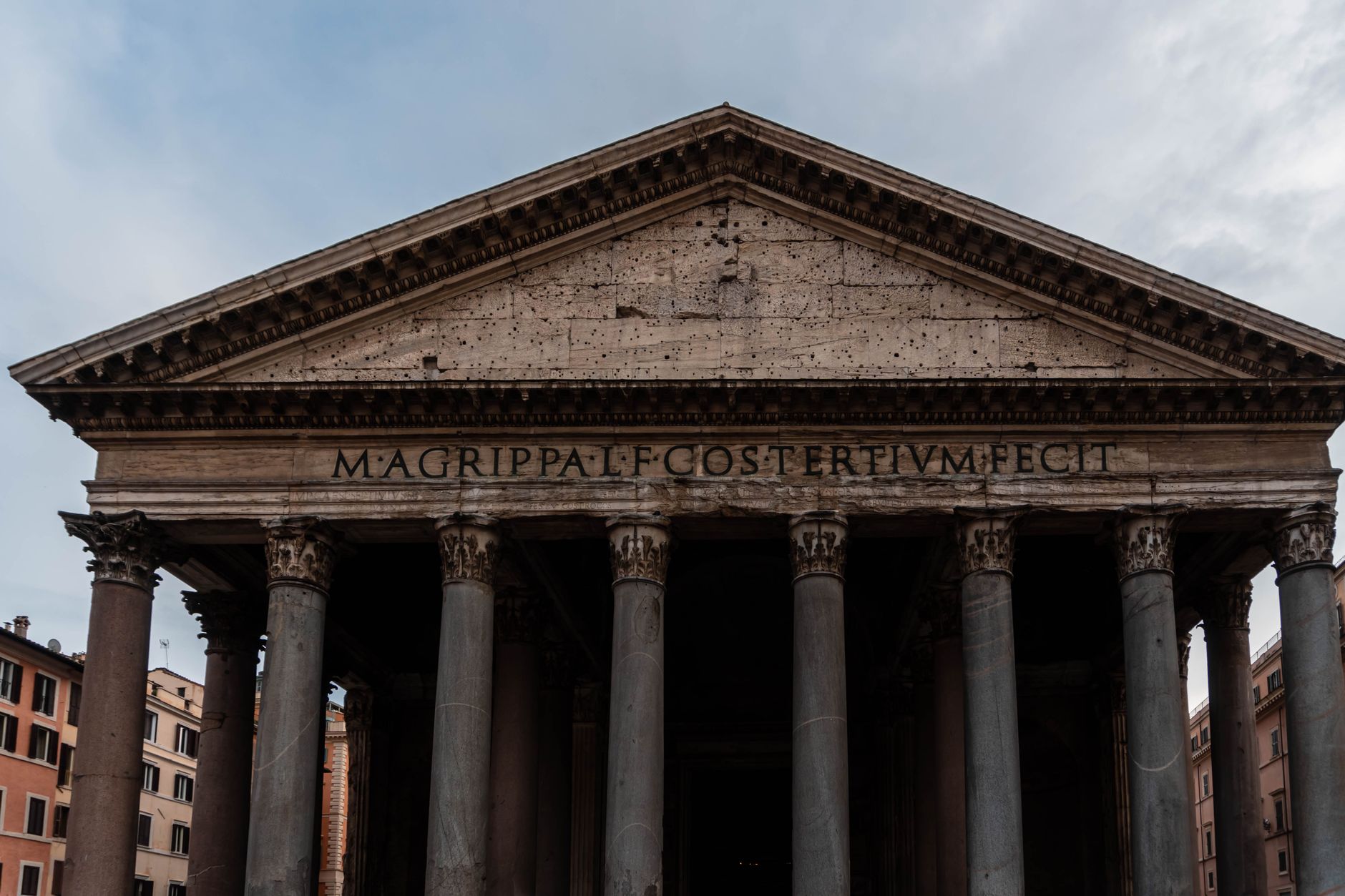
Walk up to the Pantheon in Rome and the inscription across its porch reads, in Latin, that Marcus Agrippa built it. He did not build the structure standing there today. That building is almost entirely the work of the emperor Hadrian, finished around 125 AD, nearly a century and a half after Agrippa's original temple on the same site had already burned down. Few surviving ancient buildings carry a more misleading label on their own facade.
Agrippa's lost original temple
The first Pantheon was built by Marcus Vipsanius Agrippa, Augustus's close friend and son-in-law, and dedicated around 25 BC as part of his broader building program in the Campus Martius. Ancient sources, including Pliny the Elder, describe this earlier building, and archaeological excavation has confirmed it had a rectangular plan facing south, quite unlike the domed rotunda visible today. This original structure was damaged by fire in 80 AD and again in 110 AD under Trajan, after which almost nothing of Agrippa's building survived to be reused.
Hadrian's rebuild and the dome that still stands
The emperor Hadrian undertook a complete reconstruction on the same site, likely completed around 113 to 125 AD, choosing to keep Agrippa's original dedicatory inscription on the new porch rather than claim credit for himself, which is part of why the building has been misattributed for centuries. Hadrian's design abandoned the rectangular plan entirely in favor of a vast cylindrical drum topped by the largest unreinforced concrete dome in the world, a record the Pantheon still holds among ancient and even most modern concrete domes. The dome's central opening, the oculus, is about 30 Roman feet across and remains permanently open to the sky, letting in both daylight and rain, which drains through a floor built with a slight slope and hidden channels.
| Phase | Date | Builder / Event |
|---|---|---|
| Original Pantheon | c. 25 BC | Built by Marcus Agrippa; rectangular plan |
| First fire | 80 AD | Damaged under Titus |
| Second fire | 110 AD | Further damage under Trajan |
| Hadrianic rebuild | c. 113-125 AD | Complete reconstruction as a domed rotunda |
| Minor restorations | 202 AD | Under Septimius Severus and Caracalla, per a second inscription |
| Christian conversion | 609 AD | Consecrated as the church of Santa Maria ad Martyres |
Why the building survived when so much else did not
The Pantheon owes its remarkable preservation largely to its conversion into a Christian church in 609 AD, under Pope Boniface IV, after the Byzantine emperor Phocas gave the building to the papacy. Once consecrated as a church, it was protected from the systematic stripping of building materials that destroyed or reduced many other ancient Roman structures over the following centuries. Its bronze doors, among the oldest surviving Roman bronze doors still in their original location, and much of its coffered concrete ceiling survive intact as a direct result of this continuous religious use, first pagan and then Christian, rather than abandonment.
A temple to which gods, exactly?
Ancient sources are not perfectly specific about every deity honored at the Pantheon, though the name itself, from Greek pan ('all') and theos ('god'), signals a dedication to the gods collectively rather than one deity alone. Some ancient interpretation connects its design, including the dome representing the heavens and the seven niches inside possibly corresponding to planetary gods, to a cosmic religious symbolism, though this reading is partly a later scholarly inference rather than a certainty confirmed by an ancient source explaining the architect's intent. What is confirmed is that it stood apart from single-deity state temples like the Temple of Saturn or the Temple of Jupiter Optimus Maximus on the Capitoline Hill, which each served one specific state cult.
Influence on later architecture
The Pantheon's dome inspired architects for more than a thousand years after Hadrian's workmen finished it. Renaissance architects, including Filippo Brunelleschi before he designed the dome of Florence Cathedral, studied the Pantheon's proportions directly, and Michelangelo reportedly called its dome the work of angels rather than human hands. The building's influence extends to numerous later domed structures modeled explicitly on its form, from various national capitols to university rotundas, making it one of the most architecturally imitated single buildings from the ancient world. This afterlife as a design template is itself a form of ongoing historical significance separate from its original religious function, and it is part of why the Pantheon remains one of the most visited ancient structures in Rome today, alongside sites like the Roman Forum.
What you can still see there today: a visitor checklist
- The original Roman bronze entrance doors, still functioning on their ancient hinges.
- The coffered concrete dome, unreinforced and still the largest of its kind from antiquity.
- The open oculus at the dome's apex, with its light pattern shifting across the interior through the day.
- The granite columns of the porch, quarried in Egypt and transported at considerable expense and effort.
- The tomb of the painter Raphael and the tombs of Italian kings, added long after the building's ancient use.
- Agrippa's dedicatory inscription on the porch architrave, misleading as it is about the building's actual age.
Common mistakes about the Pantheon
- Believing the current building is Agrippa's original temple. The inscription names Agrippa, but the standing structure is Hadrian's rebuild, completed roughly 150 years after Agrippa's dedication.
- Assuming the dome used reinforced concrete. Roman concrete here contained no steel reinforcement; the dome's stability instead depends on its graduated thickness and lightweight aggregate near the top.
- Thinking the oculus has ever been covered. It has remained open since antiquity, and the sloped floor with drains was a deliberate original design feature, not a later repair.
- Treating 'Pantheon' as a Roman word. It is a Greek-derived name applied to a distinctly Roman building type and function.
The Pantheon's survival as a working religious building across two different faiths makes it an unusual case study next to sites like the Temple of Vesta, which never made that transition and survives only as ruins. For more sites from this period, see the sacred places and monuments category.
Sources
- Pliny the Elder, Natural History (Book 36) — Describes Agrippa's original Pantheon building and its materials.
- Cassius Dio, Roman History (Book 53) — Records Agrippa's construction and later notes on the building's history.
- Suetonius, Life of Hadrian (General (via later biographical tradition)) — Context for Hadrian's extensive building program including temple reconstructions.
Frequently asked questions
Who really built the Pantheon?
Marcus Agrippa built the original Pantheon around 25 BC, but that building burned down. The structure standing today, including its famous dome, was built by the emperor Hadrian, completed around 113-125 AD, who kept Agrippa's original inscription on the new porch.
Why does the Pantheon's dome have a hole in the top?
The opening, called the oculus, is about 30 Roman feet wide and was a deliberate original design feature, not damage. It lets in light and rain, which drains away through a slightly sloped floor and hidden channels, and it also reduces the structural load at the dome's weakest point.
Why has the Pantheon survived so much better than other ancient Roman buildings?
Its conversion into a Christian church in 609 AD protected it from the stripping of stone and bronze that damaged many other ancient structures once they fell out of use, allowing much of its original fabric, including its bronze doors, to survive intact.
Is the Pantheon dedicated to one god or many?
Its name means 'all the gods' in Greek-derived terms, and it was a temple to the gods collectively rather than a single deity's state cult, unlike temples such as the Temple of Saturn or the Temple of Jupiter Optimus Maximus.