
Lares and Penates: The Gods of the Roman Household
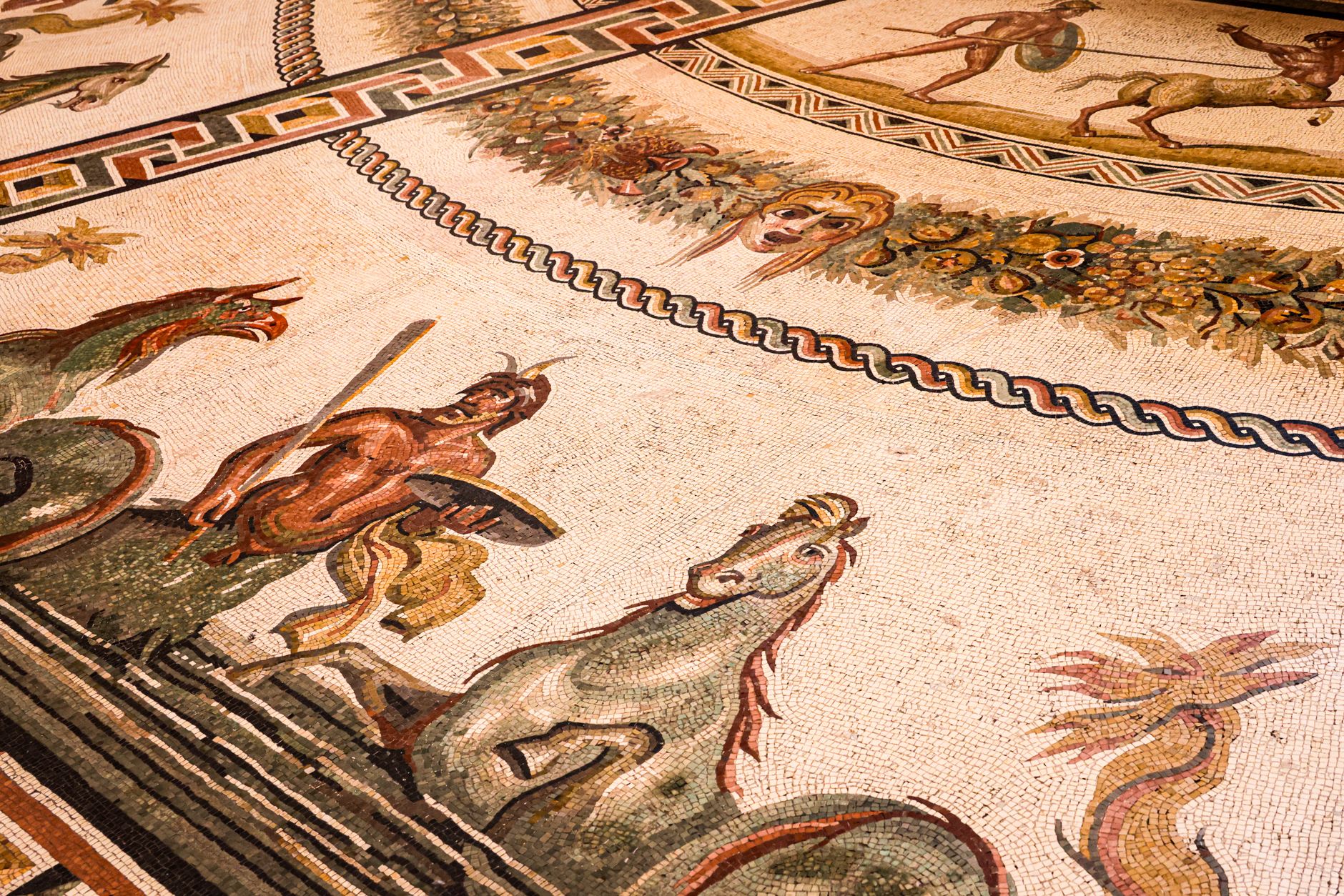
Walk into a well-off Roman house and you would likely find a small shrine near the entrance or kitchen, a lararium, holding little painted or bronze figures. These were not decorations. They were the Lares and Penates, and skipping a daily nod to them was, for most Romans, not something you would risk.
Two different kinds of household god
The Lares and the Penates are often lumped together, but Roman sources distinguish them. The Penates (from penus, the household's store of food) were originally guardians of the family's food supply and storeroom, tied to the physical pantry and hearth. The Lares were spirits more broadly linked to a place, whether a household, a crossroads, or eventually a whole city district, and seem to have had a looser, more ancestral or locale-bound character. Both lacked any real Greek equivalent; Roman household religion built its own distinct categories for these protective spirits rather than borrowing a ready-made Greek framework.
Roman writers themselves were not always precise about the boundary between the two, and the terms could overlap in practice. Cicero and later antiquarians treat the Penates as older and more closely tied to a family's specific physical provisions, while the Lares carried a slightly more personal, almost ancestral tone, as though tied to the spirits of place and perhaps even to deceased family members watching over the living, though ancient sources differ on exactly how literally to take that connection to the dead.
The Lares familiares and the lararium
Each Roman household kept its own Lares familiares, guardian spirits of that specific family and home. The lararium, a small shrine often resembling a miniature temple facade, held statuettes of the Lares alongside, often, the family's Genius (the personal guardian spirit of the household's male head) and sometimes other favored deities. Offerings, usually simple, food, wine, incense, were made at meaningful moments: before meals in some households, on birthdays, and especially at the Kalends, Nones, and Ides, the three fixed marker days of the Roman month. A new bride in some households was expected to make an offering to her new home's Lares as part of settling into married life, a small ritual act that formally marked her transition into the family's religious community, not just its physical household.
The Lares compitales and the crossroads cult
Beyond the household, Lares compitales guarded crossroads (compita) and, by extension, the neighborhoods that met there. Their festival, the Compitalia, was a movable holiday announced yearly, with shrines set up where roads crossed. This is a case where a "household" category of god scaled up into a genuinely civic one: the same religious logic protecting one family's threshold protected a whole neighborhood's shared space. Augustus reorganized this cult significantly, creating the Lares Augusti, pairing the traditional crossroads Lares with his own Genius, a move that quietly inserted the emperor's person into the most local, everyday layer of Roman religious life, down to street-corner shrines in every neighborhood of the city. These Augustan-era compital shrines were maintained by freedmen officials called the vicomagistri, giving freed slaves and lower-status citizens a visible, officially sanctioned religious role in their own neighborhoods, something the older, purely aristocratic state priesthoods rarely offered.
Lares, Penates, and Genius compared
| Spirit | Protects | Typical location | Scale |
|---|---|---|---|
| Penates | The household's food stores and basic provisioning | Storeroom, hearth | Single household; state-level Penates existed too, tied to Rome's foundation legend |
| Lares familiares | The family and home generally | Lararium shrine | Single household |
| Lares compitales | A neighborhood crossroads | Street-corner shrine | Local district, later citywide under Augustus's reform |
| Genius | An individual person's own life-force, especially the household head's | Honored within the lararium | Single person |
Checklist: how to identify household-god worship in Roman evidence
- A small shrine-like niche built into a wall near a kitchen, entrance, or atrium, often painted or carved like a tiny temple.
- Small figurines of paired or grouped youthful dancing figures, a common form for Lares in surviving bronzes and wall paintings.
- Offerings of food scraps, wine, or garlands left at the shrine, especially noted at Pompeii and Herculaneum.
- Inscriptions mentioning "Lares Augusti" indicate the Augustan-era reform of the crossroads cult specifically, not the older household-only version.
Common mistakes about Lares and Penates
A frequent mistake is treating "Lares and Penates" as a single interchangeable phrase for all household gods; ancient Romans distinguished their functions, even if the two categories were honored together in the same shrine. Another mistake is assuming these were minor folk superstitions beneath serious religion; the state itself kept public Penates, tied to the legend that Aeneas carried both Vesta's sacred objects and the Penates from Troy to Italy, meaning the household-god framework scaled all the way up to Rome's own founding story. A third mistake is assuming no Greek category resembles this at all out of simple ignorance; in fact, ancient Romans themselves noted the absence of a tidy Greek parallel, treating the Lares in particular as a recognizably native feature of Roman religion rather than an imported one.
Why household gods matter for understanding Roman religion
Public cult, directed at gods like Jupiter or the Dii Consentes, gets most of the attention in surviving literature, but the Lares and Penates remind us that Roman religious life was lived daily, at a household scale, by people who never set foot in a major temple most weeks. This domestic layer of religion, not myth-heavy and not politically prominent, was arguably the most continuously practiced form of Roman worship across all classes. For Rome's full catalog of deities including the Lares, see the gods and goddesses category page or the Lares library entry.
Sources
- Virgil, Aeneid (Book 2, on Aeneas carrying the Penates from Troy) — Links the household Penates to Rome's foundation legend at a state level.
- Ovid, Fasti (Book 5, on the Lares and related household rites) — Describes household and crossroads ritual practice.
- Cicero, De Legibus (discussion of household religious duty) — Reflects elite Roman views on the seriousness of domestic cult obligations.
Frequently asked questions
What is the difference between Lares and Penates?
The Penates were originally tied specifically to a household's food stores and pantry, while the Lares were guardian spirits of a place more broadly, whether a home, a crossroads, or later a city district; both were commonly honored together at the same household shrine.
What was a lararium?
A lararium was a small household shrine, often shaped like a miniature temple, where a family kept and honored statuettes of its Lares, Penates, and often the Genius of the household's head.
What did Augustus change about the Lares?
Augustus reorganized the crossroads cult of the Lares compitales into the Lares Augusti, pairing them with his own Genius at neighborhood shrines across Rome, embedding his imperial presence into everyday local worship.
Do the Lares have a Greek equivalent?
No. The Lares are considered a distinctly Roman category of household and place-guardian spirit with no clean Greek counterpart.