
Vesta and the Sacred Fire of Rome
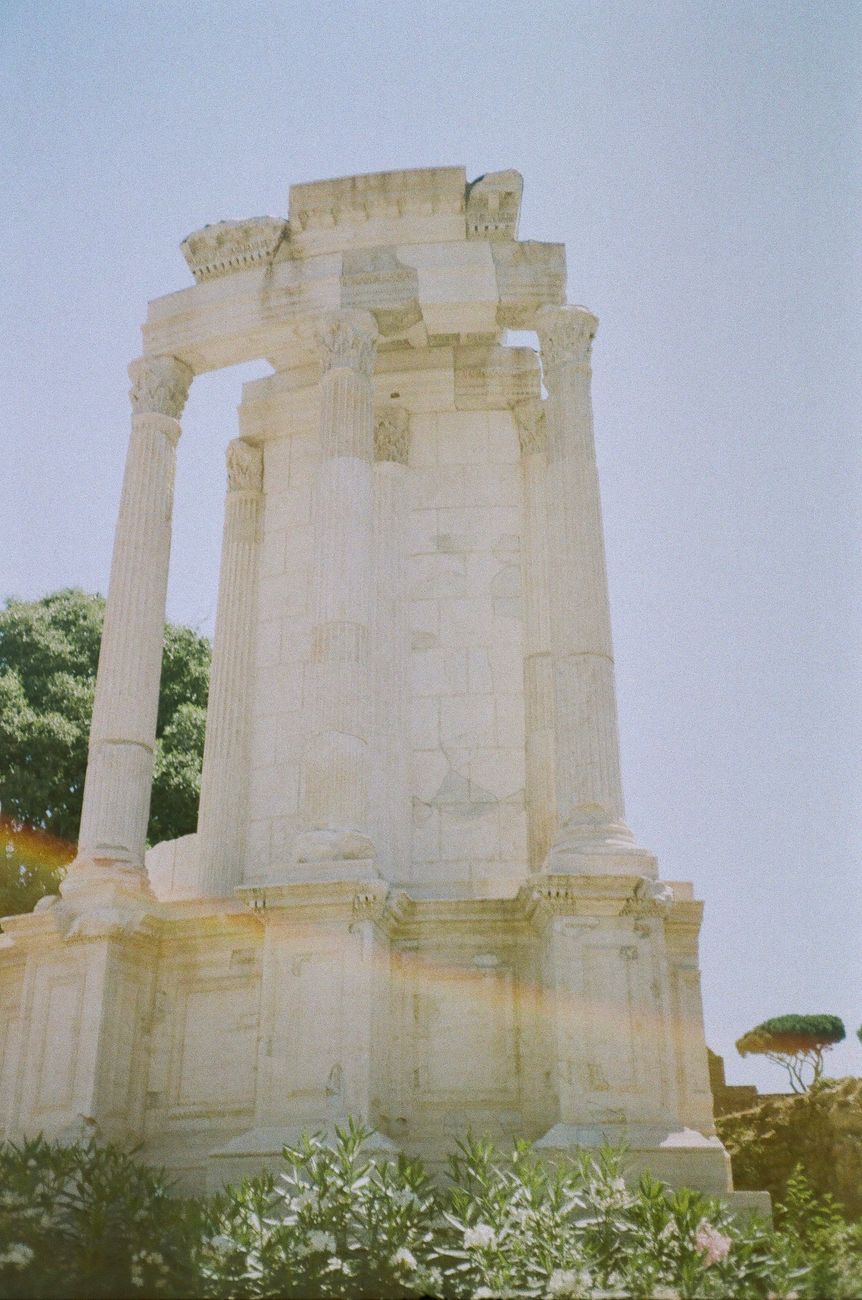
Vesta has no surviving myth worth retelling, no love affair, no quarrel with another god, and ancient Rome was fine with that. Her entire religious importance rested on one ongoing task: keeping a fire burning in a round temple at the edge of the Forum. If that fire went out, Romans treated it as a genuine civic emergency, not a minor housekeeping failure.
A goddess without a story
Vesta's near-total absence from Roman mythological narrative is itself the point. She was not a character Romans told stories about; she was a presence Romans maintained through unbroken ritual practice. Ovid, writing in the Fasti, even says directly that Vesta is nothing but a living flame, and that no image stands for her the way a statue stands for Jupiter or Minerva. This makes Vesta one of the clearest examples in Roman religion of a deity defined entirely by function and ongoing cult duty rather than by personality or biography.
The Temple of Vesta and its sacred fire
The Temple of Vesta in the Roman Forum was round, an unusual shape among Roman temples, generally explained by ancient writers as echoing the shape of an early hut or the shape of the earth itself. Inside, six priestesses, the Vestal Virgins, maintained a continuously burning fire that was never deliberately extinguished. If it went out through neglect, the responsible Vestal could be flogged by the Pontifex Maximus, and relighting it required a specific ritual method, friction-fire from a particular kind of wood, not simply striking a new flame from an existing source. Rome treated an extinguished hearth fire as an omen of danger to the state itself.
The temple's round shape set it apart visually from nearly every other major cult building in the Forum, most of which followed the rectangular, porch-fronted design borrowed and adapted from Etruscan temple architecture. Archaeological remains show the temple was rebuilt several times after fires, including a major reconstruction after the great fire of 64 CE under Nero and again after a fire in the late first century CE, a reminder of the irony that a temple dedicated to controlled fire kept burning down through uncontrolled fire. Its final form, much of which can still be traced in excavated foundations near the Forum, dates largely to a Severan-era restoration at the end of the second century CE.
The Vestalia: June 7 to June 15
Vesta's major festival, the Vestalia, ran from June 7 to June 15 on the Roman calendar. During this period the inner sanctum of her temple, the penus Vestae, normally closed to everyone except the Vestals, was opened to Roman matrons, who came barefoot to make offerings. Bakers and millers also honored Vesta during this time, since her fire was linked symbolically to the hearth-fire used in baking bread, tying her civic role back to the most basic domestic task of feeding a household.
Civic hearth, not household hearth
| Aspect | Vesta's civic fire (Rome) | A household's own hearth fire |
|---|---|---|
| Maintained by | Six Vestal Virgins, a public priesthood | The family itself, often symbolically tied to the household Lares |
| Consequence if extinguished | Treated as a danger to the entire Roman state | A domestic misfortune, not a state matter |
| Location | Temple of Vesta, Roman Forum | Every individual Roman home |
| Who could enter the inner sanctum | Only the Vestals, except during the Vestalia | Any household member |
Vesta vs. Hestia: function, not just name
Hestia, Vesta's usual Greek counterpart, was also a hearth goddess, but Greek religion gave her no public priesthood on Vesta's scale and no citywide fire whose extinction counted as a state crisis. Vesta's cult was bound up with Rome's political survival in a way Hestia's cult in Greek city-states generally was not; the Vestals themselves held legal privileges, including the right to make a will and give testimony, unavailable to other Roman women, and their status was tied directly to their guardianship of this fire. This is a case where the shared name-equivalence used in later interpretatio Romana obscures a real difference in civic weight between the two cults.
Common mistakes about Vesta
A frequent mistake is assuming the "eternal flame" was somehow magical or never physically needed fuel or attention; in fact it needed constant, literal maintenance by the Vestals, and its failure was a human failure of duty, not a sign the goddess had abandoned Rome on her own initiative. Another common mistake is assuming Vesta had a cult statue inside her temple the way most Roman gods did; ancient sources are explicit that no anthropomorphic image of Vesta stood in her temple, only the fire itself, making her sanctuary unusual among Roman religious sites. A third mistake is collapsing Vesta and the Vestal Virgins into a single topic; Vesta is the goddess and the fire, while the Vestals were the specific priesthood serving her, with their own distinct legal status, obligations, and penalties that deserve separate treatment.
Why Vesta had no clean Greek equivalent in function
Even granting the Hestia comparison, Vesta's role as guardian of the entire Roman state's continuity, not just of hearths generally, is a distinctly Roman development. Her fire was sometimes described by Roman writers as tied to the fate of Rome itself, carried, according to legend, from Troy by Aeneas along with the Penates. Whatever the precise origin story, by the historical period Vesta's cult functioned as a piece of state infrastructure as much as a religious one. For more on deities with no clean Greek counterpart, see our article on Janus, and for the full catalog see the gods and goddesses category page or Vesta's own library entry.
Sources
- Ovid, Fasti (Book 6, on Vesta and the Vestalia) — Describes Vesta's lack of an image and details of the June festival.
- Plutarch, Life of Numa (sections on the founding of Vesta's cult and the Vestals) — Greek-authored account of the institution's early organization under Numa.
- Livy, Ab Urbe Condita (general references to the Vestals and omens of the fire) — Records moments where the fire's state mattered to Roman political life.
Frequently asked questions
Why didn't Vesta have a cult statue?
Ancient sources, including Ovid, state that Vesta was represented by her living fire itself rather than by a human-shaped image, making her temple unusual among Roman cult sites.
What happened if Vesta's fire went out?
Rome treated it as a serious omen of danger to the state. The Vestal responsible could be punished by the Pontifex Maximus, and the fire had to be relit using a specific ritual method rather than an ordinary flame.
When was the Vestalia celebrated?
The Vestalia ran from June 7 to June 15 on the Roman calendar, during which the normally restricted inner sanctum of Vesta's temple was opened to Roman matrons.
Is Vesta the same as the Greek goddess Hestia?
They share a hearth-goddess role, but Vesta's cult carried a far larger civic and political weight in Rome, including a dedicated public priesthood with unique legal privileges, which Hestia's worship in Greece did not carry to the same degree.